Wednesday, October 23, 2019

Hurdy Gurdies in the Colonial America

It's been over a month since my last post, and as usual I've been up to so weird stuff in between. Did some cool events with the boys of the 17th and have been pumping out clothes left and right for all sorts of reasons. My latest focus has been on the hurdy gurdy. I guess it's really not my latest focus, I have been obsessed with them for a few years now. What's changed is that I bought the bullet and bought one.

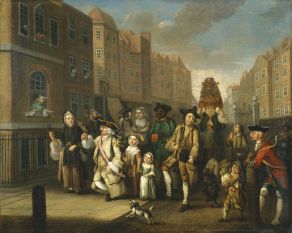
Hurdy Gurdy player is in the foreground in the tan coat from May Morning by John Collett
I won't go into the overall history of the instrument because there a tons of other way more scholarly people than I out there who have written volumes about the thing. My interest, lies in documenting the existence and use of hurdy gurdies in North America, specifically the British colonial parts.

The exercise has been more challenging than thought. Who would think that the task of discovering references to an instrument that is not specifically popular in England proper and typically associated with the lower classes of society in a region where most of the art and writings depict the the upper classes would be difficult? Add to that mix that hurdy gurdy is not always used as the reference term. I've run across references to the instrument as the hand organ, humstrum, and wheel fiddle. The first two terms can refer to instruments other than the hurdy gurdy, but the description of playing the instrument points to the HG.

I have found references though.

The earliest reference that I found is French from 1636. It comes from The Jesuit Relations. Although French, the reference does establish that HGs were in North America by 1636.

They received this answer with pleasure, begging that, as a sign of mutual rejoicing and love, some of our young people should dance to the sound of a hurdy-gurdy, that a little Frenchman held.  This was granted them, to their great satisfaction.

Then I've hit a large gap. The next reference I've found comes from the New Jersey Gazette in 1778. The entry summarizes the publications of a Philadelphia printer, exiled by the British occupation of Philadelphia, who is publishing anti-British, satirical propaganda. The entry is incredibly offense and obviously should be taken with a grain of salt since it is satire. Although the events described never occurred, I would consider this secondary evidence for the use of HGs in the American British colonies based on the author referencing them being played. 

New Jersey Gazette, 8 Apr 1778
Amongst those who left Philadelphia on the approach of the enemy to that city, a Gentleman, who had with him a portable printing-press, took refuge somewhere near Egg-Harbour.  By means of a well-conducted correspondence with a friends in the city, he obtained constant and authentic intelligence of the most minute occurrences there provided, he, for the amusement of himself and a few friends, publishes a paper every fortnight, which he calls Pasquin, or the Minute Intelligencer.
     As these papers are not for sale, and but a few copies struck off, they do not circulate and are but little known.  Being an old acquaintance, he constantly sends me one of his curious performances.  As a specimen of the work, I have selected the following articles.
     It is said the English ministry, having no hopes of subduing America by force of arms, whilst the inhabitants retain their native virtue, have instructed the officers in their army to try a more certain method of success, by debauching the morals of the men, and seducing the virtue of the women.  For this purpose playhouses are opened, gaming- tables established and balls promoted, in a city languishing under a scarcity of the necessaries of life.
     His Excellency General Howe, ever attentive to the health of his army, took the advantage of some fair weather in December last, and determined to give his troops an airing, of which they stood in great need.  For this purpose he ordered the whole of his forces out, and heading them himself, took a walk into the country.  His benevolent intention was to proceed as far as Reading and Lancaster, but finding the roads about Edge-Hill much infested with armed rebels, he thought proper to return to the city; which he did with considerable precipitation, being apprehensive of an approaching storm.  Some think he might have forced his way through the banditti, but he was too prudent a General to expend his Majesty's powder and shot on such a ragged crew.
     We have the pleasure of assuring the publick that the disputes respecting the arrangement of The Royal African Regiment are now at an end, his Excellency having determined that arrangement in the following manner:
     Quaco, Colonel
     Sambo, Lieutenant-Colonel
     Cuffey, Major
     Toney, Captain
     Cudjoe, Captain
The contest for pre-eminence between Quaco and Sambo was long and obstinant: it is evident that Sambo had the thickest lips and the whitest teeth, but his Excellency's partiality is in favour of Quaco, as he has honoured him with his company; and at the entertainment lately given by the officers of the Royal African Regiment, his Excellency opened the ball with Colonel Quaco's Lady, and danced very gracefully to the music of a full orchestra of banjoes and hurdy-gurdies. - How far the superior beauty of Colonel Quaco's Lady may have contributed to his promotion, is uncertain.

As I said, incredibly offensive. What can be gleaned from the passage is the probable presence of the HG the British colonies and the societal association of the HG with the lower classes society. A few American travel narratives include references to banjos being played at country dances, typically by the lower sorts or the enslaved.

The next reference is from Boston in 1785 and paints the picture of a rather interesting scene on the streets of the city. Although America did not have the likes of Hogarth or Collett to paint the goings on of the lower sorts in society satire, this is about as close as you're going to get. I would love to see what a satirical artist could do with this passage. Again, the persons involved with the hurdy gurdy appear to be of the lower sorts.

The final passage I've seen found thus far is related to an assault and murder that occurred in Charleston, SC on July 4, 1785. In this case, three men were heading to Yammacraw, which appears to be a market in Charleston, to hear the HG women play. On their way, they investigated a disturbance in a house at which point one of the men was stabbed in the chin with a bayonet as he descended the stairs to enter the home, and another was shot in the back from a second story window. The newspaper speculates that the reason for the attack was personal in nature based on one of the attacked men slighting the residents of the house from which the attack originated.

A secondary article that was published later, gives the account from the victims and provides more speculation for the cause of the attack. The article again mentions the HG. Although no HG was physically present in this story, I cannot help but find humor in the instrument in this case being related to crime.

That is what I have managed to collect thus far that is solely related to the Americas. I'm told from another historian that there is a HG that was made in 1775 with an American provenance based on a patriotic eagle engraved on it, but I have yet to locate the item in digital collections. I have some additional English information that I will share in a later post, but my main focus right now will be searching colonial news papers for any HG references in runaway ads, sales notices, or bulletins. Based on the association with the lowers sorts, I assume that I'm not going to find any mentions in merchant listings of goods for sale or instrument makers, but you never know. 

Wednesday, September 18, 2019

Trunk 2.0: Moo Cow Edition

Carry all your crap to events is always a blast when you're doing anything other than campaigning. I do enjoy the simplicity of putting everything in a knapsack and that being all that I carry, but occasionally I need to carry more stuff than that. On two occasions now, I have fit an entire tailor's shop into my vehicle. I try to keep all of my stuff in period appropriate containers as much as possible, and for that purpose I purchased a big wooden trunk that I found in an antique shop that needed some love. I did some simple alterations to it, gave it a fresh coat of paint, and effectively turned it into a simple wooden trunk. It looks great, stores stuff great, it's just huge and heavy.

I now present the plans for Trunk 2.0: Moo Cow Edition. These plans copy the dimensions of an 18th century trunk in the collection of the CW Foundation. I will keep my final product pretty true to the original. I plan to use the same dimensions, shape, hardware, and cow hide cover. The only thing that I do plan on changing is the tack design to include my initials, and perhaps the lining paper.
Based on the museum write-up for this piece and from my own building experience building, I believe that the pine wood used to make the box is 3/4 inches thick. I will most likely use solid boards for all of the pieces, but I may cheat and use some stain quality plywood on the side pieces that will not be seen. 

The bottom piece of the box and the two base strips will be done in solid boards  as they are exposed in originals. The small pieces to make the arched top will also be solid as well because bending plywood is stupid and probably more trouble than it's worth for something that will never be seen.

Creating an arched top is essentially making a partial barrel. My next step will be to calculate the angle used on the sides of the staves to create the arch. I will use some geometry to calculate the radius of the circle of which the arch is part. I will then use that measurement to determine the stave angle. It's some fairly simple geometry, but it's complicated enough to warrant a separate post. So with that, I end this one. 

Friday, September 6, 2019

F&I Goodness

Here's an impression that I've been trying to complete for a while now. I had grand plans to get this done back in April, but finally finished the kit in August. +2 points for at least getting it done in an A-month right? Behold, my 1750s Frederick County Maryland militiaman impression.

First and foremost, my goal for this impression was to make it visually as obnoxious as possible, and I think I did a pretty decent job with the clashing patterns, crazy colors, styles etc. Everything in this kit, is based on first person garments that are described in runway ads from the Maryland Gazette during the 1750s.

Numerous references are made to "check cotton trousers" or "check linen trowzers" being worn by landsmen and indentured farms that I simply had to make a pair. Not only do they look awesome  but they are hella comfortable in the summer.

The coat is taken from an exact runaway ad that describes a man wearing a "blue double breasted coat with large white metal buttons." I repurposed wool from an unfinished project that had already been cut to make the coat, which resulted in some fun piecing. Since most people associate double-breasted 18th century coats with military, I tried to remove as much military connotations from the coat when drafting the pattern. I used simple scalloped pieces for pocket flaps and cuffs to give it a fairly non-military look.

The waistcoat is the only thing not specifically taken from the Maryland Gazette. It's made in a Kersey that's described a Goose Turd color, which is just the obnoxious color that I was going for when completing this ensemble. I love it so much.

I debuted the whole thing at Fort Frederick's French and Indian War muster, from which these pictures are taken. In the picture of us with the wagon, in which myself,  Jacob (black coat and breeches), and Josh (tall guy in the blue breeches hauling the cart) we have some mad swagger going on as we head off to the engagement for the day.

That picture gives me a particular sense of pride as my work and tutelage is fully on display. First, I made all my own clothes (obviously), but I also made Jacob and Josh's breeches. More rewarding though, I taught Jacob the process of hat making, which allowed him to make the hat that he is wearing.

Most rewarding though, I drafted the pattern for Jacob's coat, gave him instructions on how to cut and assemble it, and then left him to his own devices. In a little over a month, he had the functional and well constructed coat that he's wearing. It's much better than my first article of clothing that I constructed not only in fit but also construction. He did an amazing job. The real pride and reward is teaching someone else this trade and watching them succeed.

One final note on the F&I Muster. People always think that re-enactor food must be terrible and consist only of stews and other single pot meals. Not true. To prove that point false I provide our dinner. A standing rib roast that we cooked on a tin reflector oven with a side of collard greens. Yes, that's right, we ate prime rib for dinner at a reenactment. You can't have swagger like us and expect to eat watery stew. It's just not gonna happen.


Tuesday, September 3, 2019

Stepping Back

Nothing history related in this post. This one is for me. It's been a rough summer for our family. After about four years of fighting, my father died of cancer at the end of July. I did not have the greatest of relationships with my father for most of my life, but we tried to fix it in the end and I think that's what really matters. A few days after he died, my daughter asked if she could go see Pop. If anything, she will have good memories of him.

Three weeks after my dad passed, our dog, Sadie, was given a death sentence of degenerative myelopathy, a nerve disease that I can only equate to canine ALS in its symptoms, severity, and rapid progression. Within three weeks, we had to put her to sleep.

It is almost unfathomable to think that a dog, who in June was so smart and agile as to move multiple barriers that I'd set in place in a hotel room to open the door with her nose and escape into the hallway, would not make it to the end of August. I wouldn't believe it, if I hadn't lived it.

A day after Sadie, another friend lost her fight with cancer.

Through all of it, trying to parent to a tiny human who really doesn't understand fully what is going on has been the trickiest thing. We told her that they were very sick, and they had to go over the rainbow but they would be better. It still breaks my heart that she simply wants to kiss the boo-boo and make it better. She may not be able to heal physical wounds, but no mental wounds are too big for her heart.

She has been the best healing power through all of it. When we came home from the vet, she was so happy and cheered because "Sadie is all better now. She went over the rainbow." She misses her deeply, but that initial reaction will stay with me for the rest of my life.

It's been a tough journey for all of us. In addition to all of the physical loss, a surprising number of people who we thought were our friends showed their true colors, and simply turned their back on us. It is beyond disappointing to find that people you for years have shared memories with, given your generosity and love, devoted your time and life to, would abandon you in such a time of need. Death is the leveler; it shows people for who they truly--both the deceased and the living.

Others have shown us the best that they truly are. The amazing amount of support that we have received from our neighbors, fellow reenactors, and colleagues has been unexpected and humbling. If you're reading this, you may be one of those people: thank you. We may put on the mask of the stiff upper lip, but we do hurt too and we do appreciate it, and you, more than you will ever know. 

Tuesday, August 6, 2019

18th Century Hair, Don't Care

Styling with my 18th century hairdo
Sometimes we do really stupid stuff in the pursuit of recreating an aspect of history. Dressing my hair in an 18th century style using period means and methods (to a reasonable extent) is by no means the dumbest, but it's probably the messiest.

So why would one even go into this venture? Surely, if you want to look ye olde timey there must be a better way? There probably is. I could wear a wig, maybe I could use modern products, but where's the fun in that? As I would come to learn at the end of this experiment, a wig or modern products just don't give you the same look at all. So wanna learn about 18th century hair stuff? Ok, here we go.

To best understand dressing 18th century hair, you should understand the complex sciences of cooking a hearty breakfast complete with bacon and pancakes. Essentially, that's what you're putting in your hair: bacon grease and pancake mix. Alright, so it's a little more complicated than that, but same basic concept.

Two major products are used for 18th century hair dressing: pompatum (pomade) and hair powder. Several period recipes for both of these products exist and can easily be found via a simple google search. In true 18th century fashion, the recipes are fairly vague and don't call for specific ingredients or include ingredients that cannot be easily obtained in the 21st century.

Applying the pompatum.
In simple terms pompatum, now called pomade, is a mixture of rendered animal fats (and occasionally beeswax) meant to hold the hair in place. Hair powder is a very fine starch that absorbs the moisture from the pompatum and locks the style in place. Each recipe can be customized in small ways, such as changing up the animal fats used, adding color to powder, scent, etc., but the effect is consistent across the board. I have used several types of pomades in my lifetime: fat based, petroleum based, and water based, and I have to say that the fat based is the best stuff by far. It holds in place unlike water based, but it doesn't run like petroleum based does.

Anyway, I didn't really feel like experimenting with different fat mixtures, starches, and recipes, so I let the ladies at American Duchess do that for me, and I used the recipes out of their new book. The recipes work well though I do have a few thoughts. Thought one being that you do not need to wash your mutton tallow. It may give you a good feeling that you're going to remove the gamey smell by washing the tallow for a week, but in reality it doesn't do anything. Take it from a guy who makes beef tallow on the regular, the smell is either going to stay or go based on the nutrient content of the fat and there's nothing you can do about it. All that washing your tallow is going to do is potentially introduce bacteria into the tallow mixture via the water and extend the process. My other thought is that after working with both beef and mutton tallow, I think that beef tallow made from true suet is a viable (and cheaper) alternative to mutton tallow. I'll try that one on my next batch though.

Freshly powdered hair.
Now I'm ready to terrorize the neighborhood kids
Both products are very simple to make and take about 30 minutes total. I was going for a simple style with buckles on the sides of my head only, so i really didn't need too many tools to style my hair. All that was needed was something to separate the hair (my wife suggests alligator clips), a makeup brush to apply the powder (she suggests a kabuki brush), a curling iron, hair ties, and bobby pins. You will also need something to cover yourself with so you don't get powder all over your clothes and a buddy to style your hair.

The first thing that you have to do after combing your hair out is apply the pompatum and powder. To do this, you section out the hair and work the pompatum in one section at a time using your hands and combs. Your hair should look greasily damp when you're done, not soaking wet. We didn't have alligator clips to easily section it out so this process took about 30 minutes using hair ties and combs.

After greasing your hair down you apply the powder with a brush. Once again, you section is out and do it one bit at a time to prevent clumping. Make sure that you absorb all of the pompatum or you will have problems later on. Again, no clips so we used hair ties and we had a crappy small brush, so it took about 30 minutes to complete. More lessons learned.

We had to pause to powder the tiny human's hair too.
Now that you have the pompatum and powder in your hair, you will look like a scary witch and are prepped to scare all the neighborhood children.

The hair looks really cool at this stage. It was at this point that I realized that trying to recreate 18th century hair with a modern wig or using modern products just doesn't cut it. The definition of colors in the hair created by the natural hair color and powder simply is not something that can be duplicated with any modern means.

The next part is styling. This is the cool part because you get to experience how crazy the pompatum and powder really is. We were just doing two curls on each temple which is pretty simple to do in theory. I didn't think I had enough hair for two curls, and Allie assured me that I have enough hair for at least five on each side. Essentially, you section out the hair for the side curls, style them, and then push everything in the center back while trying not to fry your hair or get powder everywhere.

Allie's hand for volume compairison
To make the curls, you back comb the side section, which will result in your hair literally standing on end straight off your head because that's how fricken crazy the pompatum and powder holds. Then you apply some more pompatum to the base of the hair section and then your curl. After the curl is done, you will roll it over a cylinder to hold the hard shape (we used a section of 5/8 PVC pipe, but the originals were made of clay, and then you pin it in place. You can use regular old bobby pins, but if you want to be more historically accurate you can use Amish hair pins because they look almost exactly like surviving 18th century hair pins.

And that's really it in a nutshell. Tie the rest of your hair back, put a ribbon in it, and call it a day. The powder doesn't really go everywhere once it's set in the pompatum so it's really not that messy. And getting it out it a breeze. Shampoo your hair while everything is dry, then jump in the shower and it all comes right out. Your hair will feel fantastic afterwards too because you've just given it a nice oil treatment.

So what does it feel like to wear all this crap in your hair? It's quite nice actually. Your hair isn't that heavy, and the scents from the essential oils in the pompatum and powder are quite relaxing. I don't feel greasy nor are you permanently emanating a cloud like Pig Pen from the peanuts. Everything pretty much stays in place. The product will give your hair an insane amount of volume. I have super thick hair in general, but this stuff brings that to a whole new level.

If you want to find out why the wife and I were doing this, stick around for the next post to find out. It's for a super cool even that's on the horizon.

Wednesday, July 17, 2019

Stony Point Recap

So many things can be said about this event. First and foremost: it was absolutely amazing. The organizers rocked it to create an event that was amazing for spectator and participant alike. We were having fun, so the attendees were having fun.

The scenarios themselves, like the actual battle, were absolute chaos and adrenaline. The aftermath continued with the various scraps in the prisoner corral and the women giving the Continental troops one hell of a time while being captured. Go on social media, do a search for it and you'll see all the charged interpretation that was going on. You know you've done good when the spectators are getting worried, upset, and even crying at the interpretation that they are watching.

Besides the battles, we were doing what soldiers really should have been doing. During the day, we build fortifications to prevent oncoming attacks. Well, we built them as best as we could for a place where we couldn't dig. At night, there was music and leg wrestling. The ladies did laundry, and the kids played on the rocks. The life of an 18th century British regular may seem mundane, but immersing into that role is something truly spectacular.

Allie in the completed Virginia cloth gown. 
My favorite and truly immersive moment came during a work detail, where myself and two others were sent back to camp to get some rope. When we returned to camp we found it deserted of people, but with the officers' table completely stocked. After verifying that no one was around, we raided the officers' food, much to the amusement of the few spectators who saw it. After that we got some rope, and headed back like nothing had happened. That right there is living history.

This also marked Allie's first true event, and I think she's hooked now. Perhaps it was the throwing of vegetables at soldiers, the good company of the woman in the hobby, or just the camping in funny clothes that got to her, but she's in it now. I got her a knife as her recruitment bounty and put her initials on it so that it doesn't let lost. The tiny human also had a blast and naturally all of the picture were taken of her, so I think she's hooked as well. Then again she's a toddler, and her communication skills are not the greatest.

All in all, it was one hell of a time. In the weeks leading up I nearly ran myself ragged completing: one set of stays, one regimental coat, one gown, two petticoats, one bedgown, and one child's cap all for this thing, but it was worth it. Now that these shenanigans are over, it's time to get back to some civilian life... and by that I mean sewing civilian clothing. You really didn't think that I was going to rest did you?


Wednesday, July 10, 2019

Pre-Event Cramming

No matter how much you plan, you will inevitably end up cram sewing the week or two before an event. The bigger the event the more the cramming. Sewing is Stewpid. Enter Stony Point.

As this year is the 240th anniversary, it's a capstone event. The 17th Regiment is going to be all hands on deck and showing out in impressive force. We will stepping out with numbers equal to that of an actual weakened company at 40 plus men at arms. Pretty impressive considering most units are lucky to field the strength of a single platoon. With that comes more sewing.

On the list for completion is a new kit for the wife that fits properly, and oh yeah, lets throw in a regimental coat because doing a gown and bedgown in less than 3 weeks is not enough insanity for one guy with a full-time day job.

Luckily, this regimental was being made from a partially completed loaner coat so the most (32 of 43) lace loops were already finished. It was merely a simple task (he says with retrospective gusto that was in fact profuse profanity at the time) of pulling apart the coat, recutting the pieces to fit the wearer, and then re-assembling and finishing it.

I have to say that it was an enlightening task. I did a lot of the work at Fort Frederick during a POW event. I told Fort visitors that the original wearer had died in captivity so I was remaking it to fit another soldier; that got a lot of looks. It was a bit surreal pulling apart the garment as regimental tailors would do in the 18th century to remake it to fit a specific soldier. I even cut the thing using an original pair of shears from the 18th century. It was one of those moments that you can really reach out an touch history because you are a part of it.


Around and in between doing that, I was working on the wife's stuff. I once said that I would never make lady's clothing. Since saying that, I have subsisted on a diet consisting primarily of crow. Women's clothing is not as hard as I thought it was going to be and the results have been fantastic.

I wanted her to have a cool relaxed garment and an nice garment for the summer, so she got a striped linen bedgown and a Virginia cloth gown. The bedgown was simple, but I have made one before. Since the bedgown is unlined linen, I cheated on the interior seams and machined them where I could since they will all be felled and unseen. That was an afternoon project, but the begown looks great.

Side note: Virginia Cloth is amazing if you can find it. It is a 50/50 mixture of worsted wool and cotton. The stuff looks like any worsted, but is super light and breathable. It is absolutely perfect for summer wear. I'm jealous that she will be wearing this while I am dressed in heavy drilling and broadcloth. In flash photos, it looks like a sheer that you can see though, but it's not that way in person.


The gown has been an adventure. It's not as difficult as I thought it was going to be, just different in the construction. Unlike men's clothing, where a lot of things are sewn from the inside of the garment, the outside of the garment is the working side for a gown. The process otherwise is very similar: fit the garment with a mock-up, then put it together. Ok, maybe that's a bit of an over simplification of garment construction.

Anyway, it's not that bad. I thought the pleats on the back of the gown would be very difficult to do, but with a little patience and the assistance of of a folding cheat sheet penciled on to a piece of fabric, they turned out perfectly. I was surprised to find that pleating is done flat on the exterior fabric only cut in a large rectangle. Once the pleats are stitched down, the lining is attached and cut to match the shape of the lining. It's an ingenious process that still amazes me. All in all, the gown is coming together nicely and is almost finished.

I have two more days until Stony Point, and only need to finish the sleeves and hem the skirts. Oh yeah, and make some petticoats. The struggle is real.